

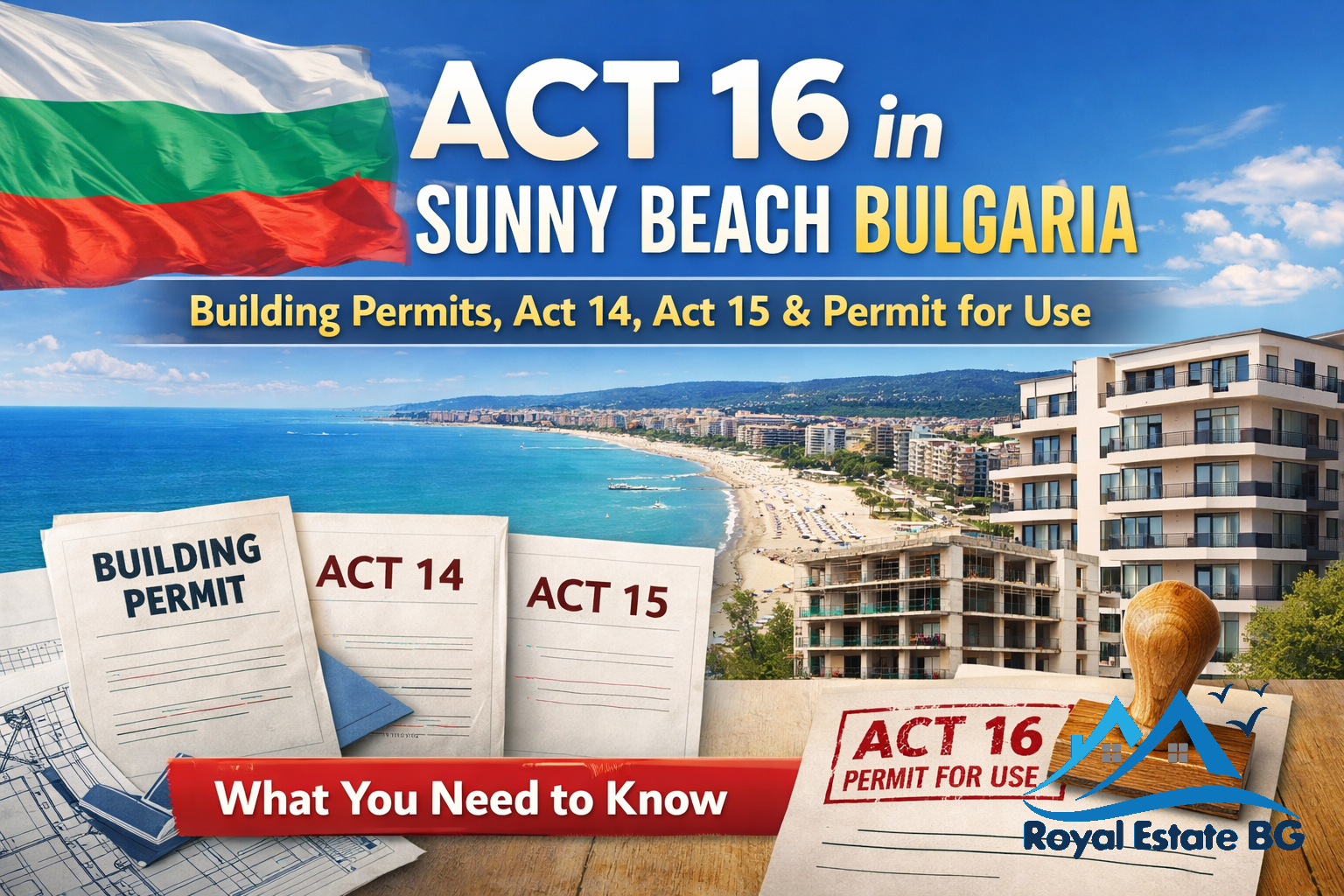
If you’re a British or Irish property owner in Sunny Beach, Bulgaria, you’ve probably heard people say: “Make sure the building has Act 16.” It comes up constantly when you try to sell, rent out, register an address, connect utilities, or even get a mortgage buyer interested.
But Act 16 is not a single “paper” that appears at the end. It’s the final step in a strict chain that starts long before construction, with the building permit and the required technical approvals.
In this in-depth guide, Royal Estate Bulgaria explains the full process clearly—from the first building permit, through Act 14 and Act 15, to Act 16—plus why Act 16 is so important when you own (or want to sell) an apartment in Sunny Beach.
The construction approval journey in Bulgaria (why these “Acts” exist)
Bulgarian construction law uses staged approvals to confirm that:
- the project is legally permitted
- the structure is built correctly (and safely)
- the building is finished according to the approved design
- the site can be legally “put into use” as a residential building
These stages protect owners, buyers, and the municipality. They also create a paper trail that matters hugely at resale—especially for foreign owners who want a clean, safe sale with no unpleasant surprises.
Step 1: The building permit – where everything starts
Before a developer can legally build, they must obtain a building permit. This is not a casual document. It confirms the project is approved for a specific plot, with a specific design, purpose, and parameters.
Typically, before the permit is issued, the project must align with:
- planning rules for the area (zoning / development parameters)
- approved architectural and engineering designs
- infrastructure requirements (water, electricity, access, etc.)
- environmental and other regulatory requirements where applicable
Why it matters to you as an owner/seller in Sunny Beach:
- If a building was started without a valid permit (or with serious deviations), the entire project can face legal complications.
- Banks, serious buyers, and experienced lawyers look for evidence that the building’s paperwork is correct from the very beginning.
- If you are buying off-plan or reselling a “new build,” the building permit is a key part of due diligence.
Step 2: Act 14 – completion of the structural frame (rough construction)
Act 14 is issued when the building’s structural shell (the “rough construction”) is completed. In plain English, this usually means:
- foundations are done
- load-bearing structure is complete (columns, slabs, main walls)
- the building has reached the stage where its form/volume is fully established
Act 14 is important because it confirms the structure exists and meets the essential construction standards at that stage.
What Act 14 does not mean:
- it does not mean the building is finished
- it does not mean the building can be used or lived in
- it does not guarantee legal occupancy
Why Act 14 matters in Sunny Beach sales:
- Many developments marketed as “nearly ready” are actually at (or around) Act 14.
- If you’re selling an apartment in a building that only has Act 14, your buyer pool is smaller (mostly cash buyers, often investors willing to take more risk).
Step 3: Act 15 – acceptance of the completed construction (handover readiness)
Act 15 comes much later. It’s signed when the construction is completed and the building is ready to be delivered/accepted by the investor/developer and prepared for the final commissioning.
At Act 15 stage, the building should generally have:
- completed common areas (to the required level)
- installed systems (electrical, plumbing, fire safety, elevators where applicable)
- compliance with the approved design and technical documentation
- readiness for final inspections and commissioning
Act 15 is effectively a declaration: “We built what was approved, and it is complete.”
Important nuance:
- A building can have Act 15 and still not have Act 16.
- Owners sometimes assume Act 15 = “all done.” It’s not. Act 16 is the legal finish line.
Step 4: Act 16 – the Permit for Use
Act 16 is the milestone everyone cares about because it confirms the building is officially approved for use. In many everyday conversations, “Act 16” is used as shorthand for the final commissioning/occupancy authorization.
What Act 16 means in practice:
- the building has passed final inspections
- the competent authorities accept it as compliant and safe
- the building is officially allowed to be used for its intended purpose (often residential / holiday residential)
In other words: Act 16 is the legal “permission to use” the building.
Why Act 16 is critical for apartment owners (especially foreign owners)
If your apartment is in a building without Act 16, it can create serious, real-world problems—two of the biggest are:
- You may not be legally allowed to live/register residence there
Without Act 16, the building is not fully commissioned for residential use. This can affect:
- address registration / “residence” procedures
- legal certainty for long-term living
- buyer confidence (buyers ask: “Is this building legally usable?”)
- Electricity can be commercial (higher tariffs) instead of residential
A very common issue in buildings without Act 16 is that electricity is supplied under commercial terms, which can mean:
- higher electricity costs
- different contractual arrangements
- ongoing uncertainty until the building is properly commissioned
Other common consequences of missing Act 16:
- Harder resale: serious buyers often walk away; banks usually won’t finance
- Lower market value: buyers demand a discount for legal/utility risk
- Insurance and liability complications: insurers can be cautious or restrictive
- Ongoing “temporary” status: years can pass while paperwork, inspections, or infrastructure issues drag on
In Sunny Beach, where many buyers are international and risk-aware, Act 16 can be the difference between a smooth sale and a frustrating listing that sits unsold.
How Act 16 impacts selling property in Sunny Beach Bulgaria
If your goal is to sell property in Sunny Beach Bulgaria, Act 16 is one of the first documents buyers ask about—often before they even view the apartment.
Here’s how it changes your selling position:
- With Act 16:
- easier to attract mortgage-capable buyers (where available)
- smoother legal process and fewer red flags
- stronger negotiating power on price
- faster timeline from offer to notary completion
- Without Act 16:
- smaller buyer pool (mostly cash + higher risk tolerance)
- buyers demand protective clauses and discounts
- more questions about utilities, legality, and future commissioning
- slower deal flow and more dropouts during due diligence
Royal Estate Bulgaria sees this in real transactions: Act 16 is not “just admin”—it’s marketability.
Why some buildings in Sunny Beach still don’t have Act 16
There are several reasons a building might be delayed or stuck:
- incomplete or incorrect paperwork submitted for commissioning
- deviations from approved project/design that must be corrected
- infrastructure requirements not finalized (connections, access, compliance systems)
- disputes between developer, contractors, or owners’ association
- administrative delays (and yes, sometimes poor developer management)
The key point: owners often can’t “fix it fast” on their own—so when selling, you must present the situation transparently and price/market it correctly.
What documents buyers and lawyers usually check (Act 16 due diligence)
When a buyer is serious, their lawyer typically requests a document set that may include:
- proof of ownership (your title deed / notary deed)
- building commissioning status (Act 16 / permit for use)
- building documentation references (including Act 14 / Act 15 where relevant)
- encumbrance checks (mortgages, liens, claims)
- tax status and annual dues (common maintenance fees in resort properties)
- confirmations about utilities and contracts
This is where working with a strong local agency matters: we know what buyers will ask for, and we prepare the file properly from day one.
How Royal Estate Bulgaria helps you sell safely (even when paperwork is complicated)
Whether your apartment has Act 16 or not, Royal Estate Bulgaria helps you sell with a strategy that protects you and keeps buyers confident:
- clear pre-check of documents and building status
- pricing strategy based on real buyer behavior in Sunny Beach
- honest marketing that prevents wasted viewings and failed negotiations
- coordination with proven legal experts for a correct notary transfer
- support if you are in the UK/Ireland (including power of attorney options where appropriate)
If you’re not sure what your building’s status is, we can help you verify it and explain what it means for your selling price and timeline.
Request a free online property valuation!
Sell your property with Royal Estate Bulgaria!
Contact Royal Estate Bulgaria!
Common mistakes owners make with Act 16 when selling
- Assuming Act 15 is “good enough” and advertising the apartment as fully ready
- Hiding the lack of Act 16 (buyers find out during checks and lose trust)
- Overpricing as if the building is fully commissioned
- Not clarifying the utility situation (especially electricity tariff type)
- Using a non-local agent who doesn’t understand Bulgarian documentation and buyer concerns
FAQ: Act 16 and selling in Sunny Beach
1) How do I check if my building in Sunny Beach has Act 16?
Usually through the building’s documentation file, developer/management company records, and professional legal checks. If you contact Royal Estate Bulgaria, we’ll guide you on the most practical way to confirm it for your specific building.
2) Can I sell an apartment in Bulgaria without Act 16?
Yes, it’s possible—but it’s typically harder and often attracts mainly cash buyers. Expect more negotiation and deeper due diligence.
3) Why is electricity often more expensive without Act 16?
Because many non-commissioned buildings operate under commercial supply arrangements. That often means higher tariffs and less certainty until the building is officially approved for use.
4) Can I live in a building without Act 16?
In many cases, you are not legally supposed to reside in a building that hasn’t received final permission for use. Even if people do live there in practice, it creates legal and administrative risk.
5) Does Act 16 affect the price of my Sunny Beach apartment?
Yes. Apartments with Act 16 are generally easier to finance, easier to insure, and easier to resell—so they typically command stronger prices and sell faster.
6) I’m in the UK/Ireland—do I need to travel to Bulgaria to sell?
Often, no. Many sellers complete the process using a properly prepared power of attorney and coordinated legal support. Royal Estate Bulgaria can explain the typical process for overseas owners.
Ready to sell your Sunny Beach property with clarity and confidence?
If you own an apartment in Sunny Beach and you’re unsure about Act 16—or you already know the status and want the best plan to sell—talk to a local expert team that deals with these cases every week.
Contact Royal Estate Bulgaria to request a valuation and a realistic selling strategy based on your building’s documentation and the current buyer demand in Sunny Beach.


)